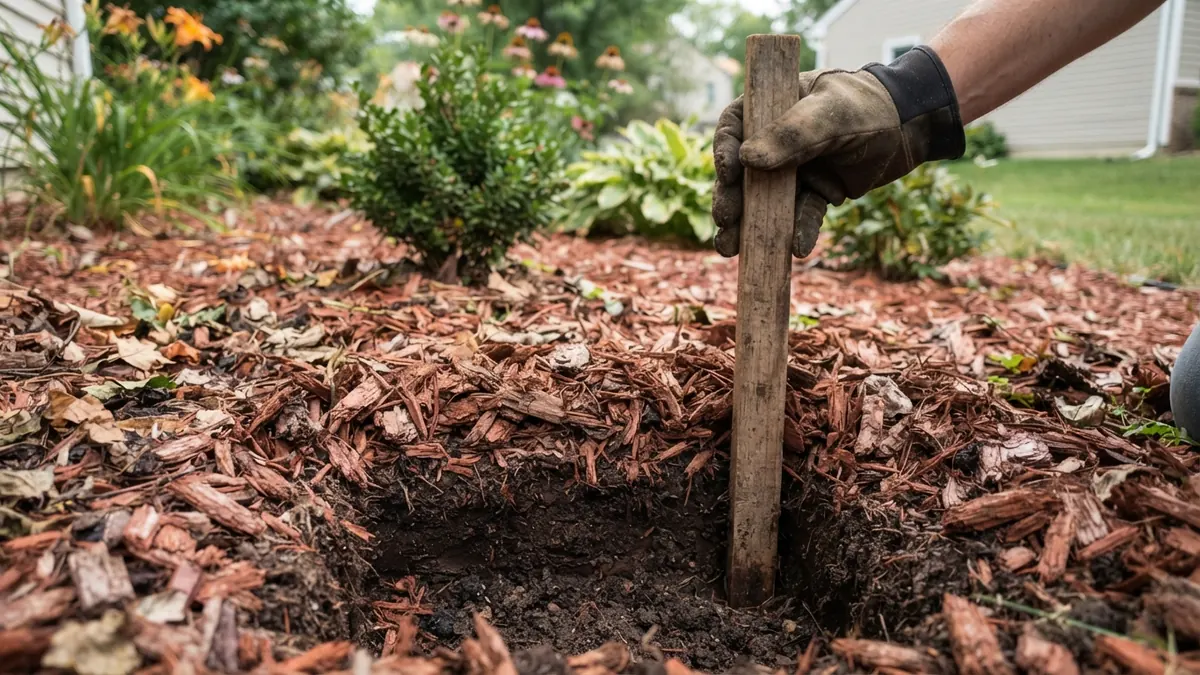
Most landscapers apply mulch at 3 inches and move on. That's the right call in most situations — but not all of them. Mulch depth affects moisture retention, weed control, root temperature, and yes, whether you're accidentally killing the plants you're trying to protect.
Once you know the right depth for your situation, the mulch calculator will tell you exactly how many cubic yards to order.
The Depth Reference Guide
| Application | Recommended Depth | Why |
|---|---|---|
| General flower beds | 2–3 inches | Weed control without smothering shallow roots |
| Tree rings | 2–3 inches | Moisture retention; keep away from trunk |
| Vegetable gardens | 2–3 inches | Moisture, warmth; avoid direct stem contact |
| Slopes and hillsides | 3–4 inches | Prevents washout during rain |
| Paths and walkways | 3–4 inches | Stable footing without sinking |
| Playground safety surface | 6–12 inches | Shock absorption — ASTM safety standards |
| Weed suppression priority areas | 3–4 inches | Prevents light from reaching weed seeds |
| Top-dressing existing mulch | 1 inch | If existing layer is still 2+ inches |
| Acid-loving plants (azalea, etc.) | 2–3 inches pine bark | Maintains soil acidity as it breaks down |
Why Too Thick Is a Real Problem
The internet loves to say "more mulch is better." It isn't. Over-mulching causes real damage:
- Root suffocation — thick mulch creates an oxygen barrier. Fine feeder roots migrate up into the mulch layer looking for air and then die when it dries out.
- Moisture barrier — counterintuitively, mulch over 4–5 inches can repel rainfall rather than absorb it, forming a hydrophobic mat that sheds water away from the root zone.
- Crown rot — mulch piled against plant crowns and tree trunks stays wet and creates conditions for fungal rot. This is how "volcano mulching" kills trees over several years.
- Rodent habitat — thick mulch near foundations gives rodents excellent cover and nesting material.
Why Too Thin Also Fails
Under 2 inches and weed seeds germinate right through. Under 1 inch in summer and you're getting essentially no moisture retention benefit — the sun dries the soil through that layer within hours.
The 2–3 inch range works because it's thick enough to block most light from reaching weed seeds while still allowing gas exchange and water penetration.
Does Mulch Type Change the Depth?
Somewhat. Coarser mulches (large bark nuggets, wood chips) can go a little thicker — up to 4 inches — because they leave more air gaps. Fine-textured mulches (shredded hardwood, cocoa hull) compact more densely and should stay at 2–3 inches.
Fine-Texture Mulches
- Shredded hardwood — 2–3"
- Dyed shredded — 2–3"
- Cocoa hull — 1–2"
- Pine straw — 2–3"
Coarse-Texture Mulches
- Large bark nuggets — 3–4"
- Wood chips — 3–4"
- Pine bark mini-nuggets — 2–3"
- Rubber chips — 3–4"
The Tree Ring Exception
Trees are the most common victim of over-mulching. The rules are simple but frequently ignored:
- Maximum 2–3 inches of mulch around trees
- Keep mulch at least 2–3 inches away from the trunk itself
- Extend the mulch ring out to the drip line if possible — a 3–4 foot radius minimum
- Never pile mulch against bark — the contact causes rot and can girdle the tree over time
Refreshing vs. Replacing
Check your existing mulch before ordering. Measure the depth in a few spots. If it's still 2+ inches and just looking faded, a 1-inch top-dress is all you need — that's one-third of the material cost of a full application.
If it's compacted, matted, or under 1 inch, rake out the old material and start fresh. Matted mulch blocks water penetration more than no mulch at all.
📖 The International Society of Arboriculture mulching guide covers proper depth and placement around trees with research-backed recommendations.
Once you know your depth, plug your measurements into the mulch calculator — it gives you cubic yards, bag count, and accounts for waste. Also check the landscape rock calculator if you're thinking about switching some beds to rock for lower maintenance.