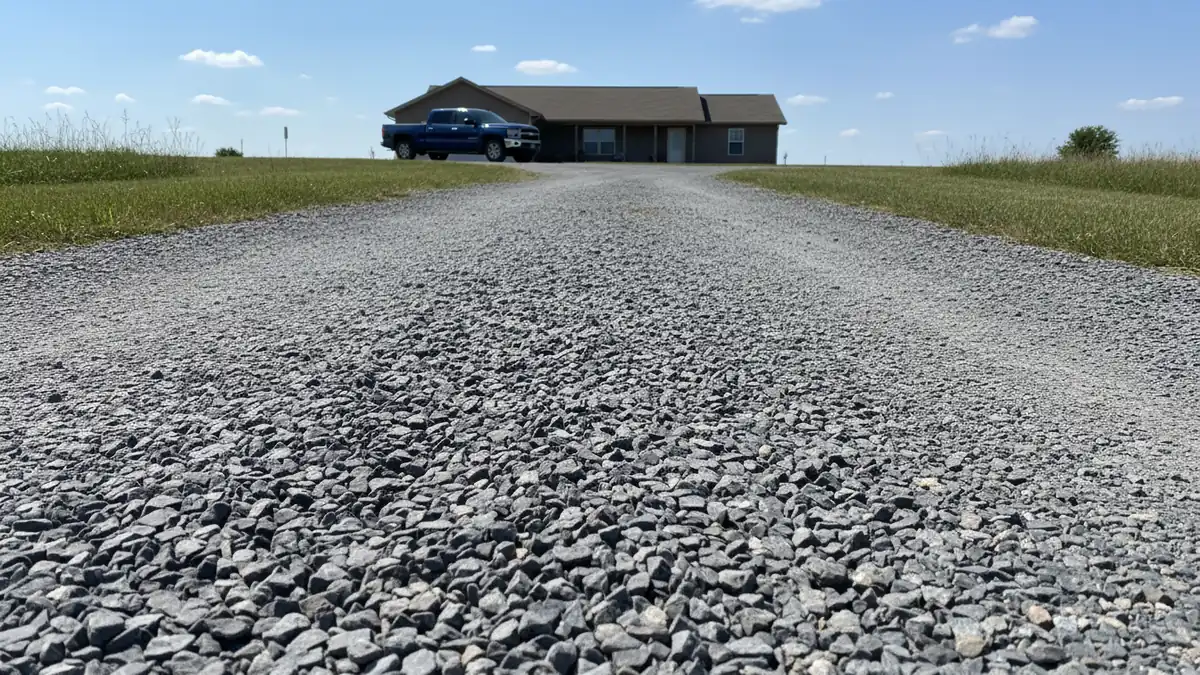
A gravel driveway done right lasts 15–20 years with minimal maintenance. Done wrong — wrong stone type, wrong depth, no base layer — it ruts, washes out, and looks rough within a couple of seasons. The difference is mostly in the planning.
Use the gravel calculator to get your tonnage before calling suppliers. Stone is sold by the ton and prices vary enough by region that knowing your volume first puts you in a better negotiating position.
How to Calculate Gravel for a Driveway
Crushed stone has a density of approximately 1.5 tons per cubic yard. Pea gravel runs about 1.4 tons/yd. Limestone is closer to 1.6 tons/yd.
Example: A 50 ft × 12 ft driveway at 4 inches deep with crushed stone:
(50 × 12 × 0.333) ÷ 27 × 1.5 = 11.1 tons
Standard Driveway Depth by Layer
A proper gravel driveway has layers, not just one dump of stone. Each layer serves a purpose:
| Layer | Material | Depth | Purpose |
|---|---|---|---|
| Subgrade (existing) | Native soil (graded) | — | Foundation |
| Base Layer | #21A or crusher run | 4–6 inches | Structural strength, drainage |
| Middle Layer | #57 crushed stone | 3–4 inches | Drainage, transitional layer |
| Top Layer | #57, pea gravel, or #9 | 2–3 inches | Appearance, drivability |
Many residential driveways skip the middle layer and just use a 6-inch base + 3-inch top. That works fine for light vehicle traffic on stable soil.
Gravel Type Comparison
✅ Best for Driveways
- #57 Crushed Stone — angular, compacts well, stays put
- Crusher Run (#21A) — mix of sizes, binds tightly, great for base
- Limestone Gravel — compacts well, accessible in most regions
❌ Not Ideal for Driveways
- Pea Gravel — round, rolls under tires, shifts constantly
- River Rock — beautiful, but too large and moves too easily
- Decorative Marble — high cost, impractical under vehicle weight
Cost Breakdown for a Typical Driveway
Assuming a 50 ft × 12 ft driveway (600 sq ft), two-layer installation:
| Item | Quantity | Cost Range |
|---|---|---|
| Crusher run base (6") | ~17 tons | $400–$700 |
| #57 top layer (3") | ~8 tons | $220–$400 |
| Delivery (per load) | 1–2 loads | $100–$300 |
| Grading labor | Half day | $300–$600 |
| Edging/containment | Optional | $100–$400 |
| Total (installed) | $1,200–$2,400 |
Common Mistakes on Gravel Driveways
- Skipping excavation — pouring gravel over grass or soft topsoil creates a spongy, rutting mess. Excavate 6–8 inches and compact the subgrade before adding stone.
- Using round stone on top — pea gravel and smooth river rock migrate out from under tires and collect at the edges, leaving the center bare.
- No crown or drainage grade — a flat driveway pools water in the center. Grade it with a slight crown (higher in the middle) so water sheds to the sides.
- Skipping geotextile fabric — without a fabric layer between soil and gravel, the stone slowly disappears into soft soil over 3–5 years.
- Ordering the wrong stone size — #57 and similar angular crushed stones are the right call. They interlock under load. Round stones don't.
Maintenance Reality
Budget for 1–2 tons of top-up stone every 2–3 years. Stone migrates to edges over time from plowing, raking, and vehicle movement. Periodic regrading with a box scraper keeps it looking good and functioning properly. That's essentially the entire maintenance program for a well-built gravel driveway.
📖 For guidance on stone specifications and grading requirements, the National Stone, Sand, and Gravel Association publishes detailed aggregate specifications by application.
Run your driveway dimensions through the gravel calculator to get your tonnage, then check the retaining wall calculator if you're thinking about containing the edges with a low curb or wall.